


Blog
Magnetic systems for recycling
In the field of waste management and processing, operational efficiency and material separation capacity are two key parameters that determine the quality of the process and the actual economic return of the entire facility. In this context, magnetic systems for recycling represent a technology that is now widely adopted in modern sorting and selection platforms.
If you are a distributor of waste treatment equipment, a technician responsible for a sorting facility, or a buyer specialising in material recovery technologies, you are probably wondering which magnetic solutions are best suited to your operational context, and what advantages they offer in terms of selectivity, durability, safety, and energy efficiency.
The words that dominate today’s market demands are reliability, automation, low energy consumption, integration with existing systems, ease of maintenance, and high precision. These are all characteristics that magnetic systems for recycling are capable of delivering, provided they are correctly chosen, carefully designed, and properly sized to meet real operational needs.
In recent years, growing attention to environmental sustainability, increasingly stringent European regulations, and rising competitiveness in the material recovery sector have pushed companies to modernise their facilities and adopt cutting-edge separation technologies, among which magnetic systems stand out in particular.
These solutions make it possible to separate ferrous metals from other materials automatically, continuously, and with high precision, optimising the production cycle and increasing the value of the recovered material.
However, not all magnetic systems are the same, nor are they suitable for every facility: each solution addresses specific operational requirements and types of material being processed.
In this article, we will explore what magnetic systems for recycling are, how they work, why they have become essential in the treatment of municipal solid waste, industrial waste, and metal scrap, and what their main industrial applications are.
What is a magnetic system for recycling?
A magnetic system for recycling is an industrial device designed to automatically select and separate ferrous materials (and, to some extent, non-ferrous materials through derived technologies) within streams of waste or secondary raw materials.
Its purpose is to make the selection process more efficient, continuous, and safe ,eliminating manual intervention and increasing the purity of the recovered material. Its application is crucial both for the direct recycling of metals and for the protection of downstream machinery, such as shredders, conveyor belts, screening equipment, and balers.
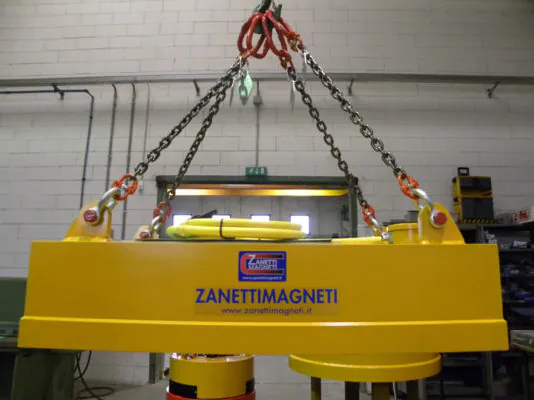
In the metal recycling sector, every second matters. Industrial electromagnets are a strategic resource for accelerating scrap collection, separation, and handling operations, reducing downtime and increasing overall plant yield. Whether dealing with vehicle hulks, discarded appliances, or waste metal components, the use of electromagnets enables faster, safer, and more efficient management ,optimising every stage of the treatment cycle and ensuring selective, automated material recovery.
Want to learn more about how electromagnets work and their practical applications in industrial settings? Read the full article: Lifting Electromagnets: How They Work, Their Advantages, and Applications.
Beyond magnetic systems, demolition and recycling equipment also plays a key role in the overall efficiency of sorting and treatment facilities. Integrating them strategically allows for better material management, faster operations, and improved process profitability.
Types of magnetic systems for recycling
Depending on their configuration and the point at which they are installed, there are several types of magnetic systems:
- Magnetic overbands: positioned above conveyor belts for the automatic removal of ferrous metals.
- Rotating magnetic drums: used at the outlet of screens or shredders for continuous, efficient separation.
- Magnetic rollers: integrated into the belt itself, ideal for fine separation in compact facilities.
- Magnetic plates: statically installed to attract metals at strategic points.
- Eddy current separators: designed to separate non-ferrous metals such as aluminium and copper.
These systems are designed to adapt to various throughput rates, belt widths, processing speeds, and material types (municipal solid waste, refuse-derived fuel, WEEE, metal scrap, mixed plastics, compost, etc.).
Want to know more? Explore our electromagnets for industrial and recycling applications.
How do magnetic systems work in recycling?
The operating principle is straightforward: it is based on the ability of a magnetic field to attract ferrous materials within a mixed stream. Once the field is generated, via permanent magnets or electromagnets, ferrous material is deflected or separated from the main flow.
Overbands and drums: belt separation
In the case of magnetic overbands, the magnetic field intercepts metals as they pass along the conveyor belt. A transverse rubber belt carries the ferrous material away, directing it to a dedicated area. This allows for fully automatic, continuous separation without interrupting the flow.
Magnetic drums, on the other hand, rotate together with the belt and “capture” ferrous metals, releasing them at a predetermined point as the magnetic field diminishes.
Eddy current separators: non-ferrous metals
To separate non-ferrous metals (aluminium, copper, zinc), eddy current systems are used: a rotating drum generates an alternating magnetic field that induces eddy currents in conductive metals. These in turn generate an opposing field that “pushes away” the non-ferrous metals, separating them from the other materials.
Permanent magnets or electromagnets?
The choice between permanent magnets and electromagnets depends on several factors, including the type of application, the operating environment, and the need for magnetic field control. Both solutions offer distinct advantages.
Permanent magnets, made from ferrite or neodymium, represent an ideal solution for applications requiring continuous operation without an electrical supply. Their main advantages are:
- No power supply required: they operate autonomously
- Compact and lightweight structure: ideal for confined spaces or mobile machinery
- Zero electricity consumption: perfect for low-energy-impact applications
- Reliability: they maintain their magnetic strength over time
Recommended applications:
- Fixed separation systems
- Continuous handling of small components
- Situations with limited access to power supply
Electromagnets offer adjustable magnetic force and the ability to activate or deactivate the field according to operational needs. Their key characteristics include:
- Adjustable magnetic force: adaptable to the type of material and load
- Fast ON/OFF switching: full control via PLC, relay, or remote control
- Greater magnetic intensity: ideal for lifting heavy or bulky materials
- Integration with automated systems: compatible with advanced industrial logic
Recommended applications:
- Demolition and scrap recovery
- Automated production lines
- Environments with variable operating conditions
Why are magnetic systems for recycling important?
Magnetic systems for recycling are essential for a wide range of reasons: economic, technical, environmental, and regulatory.
- They improve process efficiency
By automatically separating ferrous metals, manual intervention is reduced, the process is accelerated, and the overall plant yield increases. Production becomes more continuous, less prone to stoppages, and more predictable.
- They increase the quality of recovered material
Magnetic separation produces purer material streams, which are therefore more valuable. In the case of mixed waste, the removal of metals also improves the effectiveness of subsequent processing stages (such as screening, optical sorting, shredding, etc.).
- They protect machinery
Metals that are not removed can damage shredders, mills, conveyor belts, and other equipment. A well-sized magnetic system also acts as a protection mechanism, reducing machine downtime and maintenance costs.
- They meet environmental regulations
European regulations (such as the Waste Framework Directive) impose minimum recovery and recycling targets. Magnetic systems actively contribute to the achievement of these objectives.
- They improve operational safety
The removal of sharp or heavy ferrous materials reduces the risk to operators during manual handling or sorting.
Industrial applications of magnetic systems for recycling
Magnetic systems find broad application across many sectors and types of facility. Their versatility makes them indispensable at almost every stage of mechanical recycling.
- Municipal solid waste (MSW) treatment facilities
Used to separate cans, tins, iron fragments, caps, screws, and other ferrous objects found in unsorted waste. Typically integrated after pre-screening and before optical sorting.
- Metal scrap recycling
Scrap shredding plants, demolition facilities, and iron and steel recovery platforms use high-intensity drums, rollers, and overbands to separate ferrous from non-ferrous metals.
- WEEE processing
In waste electrical and electronic equipment (WEEE), magnets are used to separate screws, metal frames, sheet metal, and internal ferrous components from plastics, circuit boards, and precious metals.
- Compost and organic fraction recovery
Even in composting, the separation of ferrous foreign bodies is essential to guarantee the quality of the finished material and avoid contamination or equipment damage.
- Mixed plastics recycling
Ferrous metals are removed before optical sorting, improving system yield and polymer purity.
If you operate in the waste treatment, industrial demolition, scrap recycling, or automated sorting sectors, you know how crucial it is to adopt reliable, integrated, high-efficiency technologies.
At Zanetti Magneti, we design and manufacture custom magnetic systems for every stage of the recycling process: from ferrous metal recovery to machinery protection, through to fine separation of non-ferrous metals.
Do you have a project to develop, a plant to optimise, or simply want to consult with an expert? Contact us today: our technical and commercial team is at your disposal to help you find the most effective magnetic solution suited to your real operational needs.
FAQ – Frequently asked questions about magnetic systems for recycling
How do I choose the right magnetic system for a recycling facility?
It is essential to assess the type of material, throughput rate, plant layout, and separation objectives. A technical consultation is always recommended.
Do magnetic systems also remove aluminium?
No, but there are eddy current separators specifically designed for non-ferrous metals such as aluminium, copper, and zinc.
What is the difference between permanent magnets and electromagnets?
Permanent magnets require no power supply and have a long service life. Electromagnets offer greater power and control over the magnetic field, but require an energy source.
Do magnetic systems require maintenance?
Yes, though minimal. It is important to clean the surfaces and check the anchoring and regular operation, especially in electromagnetic models.
Are magnetic systems compatible with existing equipment?
Generally, yes. Modular and customisable versions are available that can be easily integrated onto existing belts or machinery.
How long does an industrial magnet last?
A permanent magnet can last more than 20 years if properly sized. Electromagnets require more attention, but deliver high performance.
Is it possible to separate ferrous metals from wet materials?
Yes, magnetic systems work on wet material as well, though there may be a reduction in efficiency if the material is very sticky or encrusted.
What is the average cost of a magnetic system?
It depends on size, power, and technology. Prices range from a few thousand euros for compact solutions to several tens of thousands for complex systems.
How is a magnetic overband installed?
It can be installed transversally or longitudinally to the conveyor belt, with a support structure, height adjustment, and power supply (if electromagnetic).
Is it possible to have a portable magnetic system?
Yes, battery-powered solutions with remote control are available, ideal for mobile construction sites or temporary collection platforms.