


Blog
Demolition magnets: how they work and where they are used
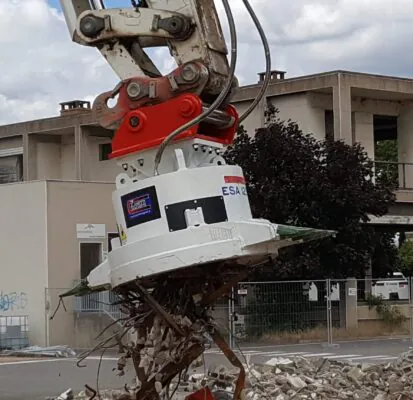
In the world of industrial demolition, every stage of the process demands precision, speed, and efficiency. But when debris starts to pile up, reinforcement bars emerge from the shattered concrete, and heavy machinery begins removing tons of rubble, one of the most critical and underestimated challenges becomes evident: the separation and recovery of ferrous materials.
This is where demolition magnets come into play, a technology that has revolutionised the industry over the past few decades, making operations faster, safer, and more sustainable. Often mounted on excavators, mobile cranes or mechanical arms, these powerful devices can easily lift, move, and separate all types of ferrous metals, such as the common rebar from reinforced concrete.
At Zanetti Magneti, we have been working for years alongside companies specialised in civil and industrial demolition, witnessing the evolution of this segment firsthand. We’ve contributed with targeted technical solutions designed to withstand the harshest environments and deliver consistent performance in all conditions.
But how exactly do demolition magnets operate? What benefits do they offer? And in which application contexts do they truly unleash their full potential?
In this article, we explore the topic in depth and from a practical perspective, with a technical yet accessible approach aimed at sector professionals, plant managers, and decision-makers seeking effective solutions to optimise demolition, recovery, and handling processes.
Why magnets are essential in demolition operations
Anyone with experience in the demolition sector knows that the job doesn’t end with bringing down a structure. In fact, it’s the following phase, managing and sorting the debris, where much of a site’s overall efficiency is determined.
On a demolition site, the types of materials involved are extremely varied: concrete, bricks, wood, plastic, but above all, ferrous metals such as:
- Reinforcement bars (rebars)
- Steel sheets and profiles
- Pipes and conduits
- Structural metal components
- Parts from old installations
These elements need to be removed not only for economic reasons but also for safety and regulatory compliance. Without magnets, everything becomes slower and more expensive.
The alternative to using a magnet is manual or mechanical separation using buckets and grabs, methods that are significantly slower and far less precise. Demolition magnets, on the other hand, make it possible to:
- Automatically extract ferrous materials from the rubble
- Separate metals during material handling
- Reduce loading times onto trucks or processing plants
- Protect machinery from collisions with hidden metal objects
Moreover, the use of a magnet increases the volume of recyclable material recovered, boosting process efficiency and enhancing the environmental sustainability of the operation.
Looking for an efficient magnetic solution? Explore our full range of professional demolition magnets.
Advantages of demolition magnets for material separation
Using a demolition magnet isn’t just a technical choice, it’s a true operational strategy. Companies that adopt this technology gain concrete benefits across multiple areas: economic, organisational, and environmental.
- Faster debris handling
Time is money, especially on construction sites. With a magnet, a single operator can clean large areas in just minutes, lifting metal directly from piles of rubble, even large ones.
- Reduced labour costs
Less need for manual sorting means fewer workers are required during the separation phase. This frees up resources for other tasks and boosts overall site productivity.
- Maximised value of recovered materials
Ferrous metal holds significant economic value. Recovering it efficiently allows for resale, lowers disposal costs, and enhances the worth of materials that would otherwise be discarded.
- Improved site safety
Sharp, heavy, or hidden metal objects in the debris can pose a serious risk to workers and damage machinery. Magnets help isolate these items quickly, reducing hazards.
- Reduced wear on operating machines
Every time a metal fragment ends up in a bucket or shredder, it causes wear and tear. Separating metals beforehand protects your equipment and extends the time between maintenance cycles.
How magnets simplify the separation of construction waste
Construction and Demolition Waste (CDW) is currently one of the primary waste streams in Europe. Effective separation is not just about regulatory compliance, such as the EU Directive targeting a 70% recovery rate for construction waste, it is also about cost efficiency.
Magnets come into play during the most chaotic phase of the process: when rubble is piled up, dirty, mixed, and irregular. In these conditions, visual or manual sorting is no longer sufficient.
A high-quality magnetic system allows you to:
- Isolate iron even in low-visibility conditions
- Operate on rugged or unstable terrain
- Act directly on unsorted stockpiles
- Automate separation prior to transport
Advanced models, such as battery-powered magnets with remote control or hydraulic excavator magnets, enable operations even in locations without a power supply, making on-site sorting possible anywhere on the job site.
The role of magnets in demolition: recovering ferrous materials
Beyond logistics, magnets play a strategic role in material recovery. Every ton of iron recovered is one less ton that needs to be mined. This results in:
- Reduced environmental impact.
- Lower extraction and transport costs.
- Increased competitiveness for the company.
In the demolition sector, iron is everywhere: in pillars, floor slabs, pipes, cladding, ventilation systems, and cable trays. Consequently, the magnet becomes a piece of equipment for the operating machine as vital as a shear or a crusher, capable of identifying and removing every single useful piece, even among mixed debris.
The difference between recovered and lost metal
A construction site that does not utilize magnets inevitably loses a portion of its ferrous materials. These end up in the inert fraction, are disposed of as mixed waste, and lose their value. Conversely, with an efficient magnet, it is possible to generate a dedicated stream of iron ready to be sold or sent for recycling, increasing margins and reducing disposal costs.
In the modern world of demolition, professional magnets are indispensable. They are not merely support tools, but true accelerators of productivity, safety, and sustainability. A well-designed and correctly installed magnet can be the difference between a slow, costly site and one that is fast, profitable, and high-performing.
At Zanetti Magneti, we put our expertise at the service of companies that want to work better, providing robust, efficient demolition magnets tailored to every need.
Do you want to know which magnet is best suited for your excavator or your next project? Do you need a free technical consultation? Contact us today: our technical-commercial team is ready to design the perfect solution for your next demolition project.
FAQ – Demolition magnets
What types of magnets are used in demolition?
Mainly hydraulic magnets, circular scrap magnets, and battery-powered magnets with remote control.
Can a demolition magnet be installed on any excavator?
Yes, a demolition magnet can be installed on many excavators, provided certain technical requirements are met. You need a hook or saddle for attachment, and a careful assessment of the excavator’s hydraulic or electrical features. With our support, it’s easy to identify the most suitable model. A ratio of approximately 1:10 between the magnet’s weight and the excavator’s weight is recommended. Plug & play solutions with integrated batteries are also available for added flexibility.
How much can a demolition magnet lift?
It depends on size and power: our most powerful model can reach over 30,000 kg (300 quintals) of lifting force.
Is regular maintenance required?
Yes, it’s important to regularly check cables, the magnetic surface, and the power supply system. Proper maintenance ensures longevity and operational safety.
How long does a battery-powered magnet last?
Operating time ranges from 6 to 10 hours, depending on usage. Batteries recharge within a few hours, and all models allow for quick replacement.
Can magnets damage non-ferrous materials?
No, magnets only affect ferrous metals. However, in environments with electronic components or sensitive boards, caution is advised due to the strong magnetic field.
How much time can be saved by using a magnet on site?
On average, metal sorting time can be reduced by 40–60%, while also improving the quality of recovered materials.
How much does a demolition magnet cost?
Prices vary widely depending on size, technology (hydraulic, electric, battery-powered), and accessories. They start from a few thousand euros and increase for larger, high-performance models.
Is it possible to rent demolition magnets?
Yes, Zanetti Magneti offers operational rental services for short-term jobs, testing, or specific projects. Customised solutions are also available.
What happens if a magnet overheats?
Professional models include thermal protection systems. If overheating occurs, the unit temporarily shuts down to prevent damage.